State of the union: surfer-owned brands
Big Surf died. Independent surfers picked up the pieces — and the data says they might actually win.

I'm not a businessman, I'm a business man. ~Jay-Z, Diamonds from Sierra Leone.
Oof, another surfer slapping a branded logo on a crewneck, oh so personalized to their oh so brilliant take on fashion.
Anti-establishment, rock hard baby… My tee logo is simple, but my airs are reversed.
Put this on your skin and shove it down your throat. You'll live to 120, or hallucinate, whichever comes first.
Ah, the retired-dad-but-I'm-only-36 lifestyle -- golfing and surfing on the same day? Me likey.
I've fallen quite ill to see yet another less-than-cerebral former pro-surfer create their own venture in, what I think is a surf-market desperate to hop on the fall of Liberation. My initial hunch was that they will all inevitably fall victim to their own lack of business acumen, failed capital management… lest we forget saturating my social feeds with ads for products I'm confident will go out of business within the next fortnight.
drags menthol cigarette, lips pursed, mind… tilts slightly to the left
Accordingly, I took a plunge into what the Surfer-owned industry has become and is becoming.
To my dismay, I was so, so wrong about where surfer-created brands are actually taking the surf industry, writ big.
What I'm about to share with you, is hopefully, slightly more compelling than your effervescent Stab Magazine "How Do Surfers Get Paid" episode, which has a suspicious obsession with glutting videos with soundbites and rumors, rather than giving you a consumable, yet comprehensive, breakdown of how the surf economy actually works.
Surely, you knew I wasn't done griping.
Abstract: This is the single most exciting and significant era of selling and buying surfer-created.
Context Proxy: Why Are Surfer-Owned Brands Grandissant?
For what seems like the better part of a decade, surfers have been socratic seminaring in circles about how "Big Surf" has fallen. A series of private equity buyout and dwindling sponsorships of reasonable monetary value climaxed in February of 2025, when Liberated Brands filed for Chapter 11 Bankruptcy. Liberated disbanded largely due to, what CEO Todd Hymel said [in court filings], as "Macroeconomic issues, including a rapid and dramatic rise in interest rates…" <insert words advised vis-à-vis PR intern>.
The reality is that Authentic Brands Group (ABG) pulled their license. Liberated didn't own the brands, ABG, did -- and as a result of being the "operator", they paid ABG for the right to produce Quiksilver, Billabong, Volcom, and RVCA in North America.
ABG simply moved their license to other operators due to the high fixed cost of "mall-shop" leases, paired with mellowed demand for "mall-like" tee-shirts. When was the last time you actively sought out a pair of thongs from Pac Sun?? As consumers shifted more towards athleisure (Vuori, Lulu, Et. al), a $460b market in America alone, paired with core surfers shifting their values to surf-owned creations, a hollowing out of Liberation's nucleus has occurred.
Surfers can now go direct to authentic "indie" surfer-owned brands that have low fixed costs (cut out royalties from licensees to operators, sell direct, keep the intellectual property as well as the ownership of your brand strength, as they are the advertised talent).
Or, Surfers can now go direct to Operators who have already scaled the operating-licensing model for Surf-Leisure + consumables, which we'll get to.
Reading between the lines, Quiksilver-esque brands crashed due to poor investment acumen from an "operator-licensee" model that failed to crack the code on the shift from mall-shop to core+athleisure. Zumiez Isn't Fucking Cool Mom, hollers the American teenager.
With that said, a ceiling has been established - if $500M+ brands ceased to innovate plain apparel, a logo-tee label never will. So, slapping on your "creative" logo to a tee is a proven no-go; thankfully Surfer-Owned brands are more dimensional than pure apparel plays.
So, my good friend, the consumer. You are right to feel queasy anytime you come across a surfer sponsoring the likes of Rip Curl and Quiksilver and Billabong. Feel free to continue to subconsciously chuckle, "This can't last long."
The Data: Who Is The Surfer-Owned Market Today?
Market sizes
| Market | 2026 size | CAGR | Source |
|---|---|---|---|
| Surfing (core equipment + apparel) | $4.73B → $6.81B by 2035 | 4.13% | Industry Research |
| Sun care | $15.7B–$19.9B | 4.7–9.7% | Fortune BI $17.52B; Mordor $19.30B |
| Sports nutrition / supplements | $57B–$77B → $101–138B by 2033 | 7.4–9.2% | Grand View $77.4B; Fortune BI $62.77B |
| Surf tourism | $7.8B–$12.1B (narrow) / $75.5B (broad) | 6.0–9.4% | Grand View; Coherent |
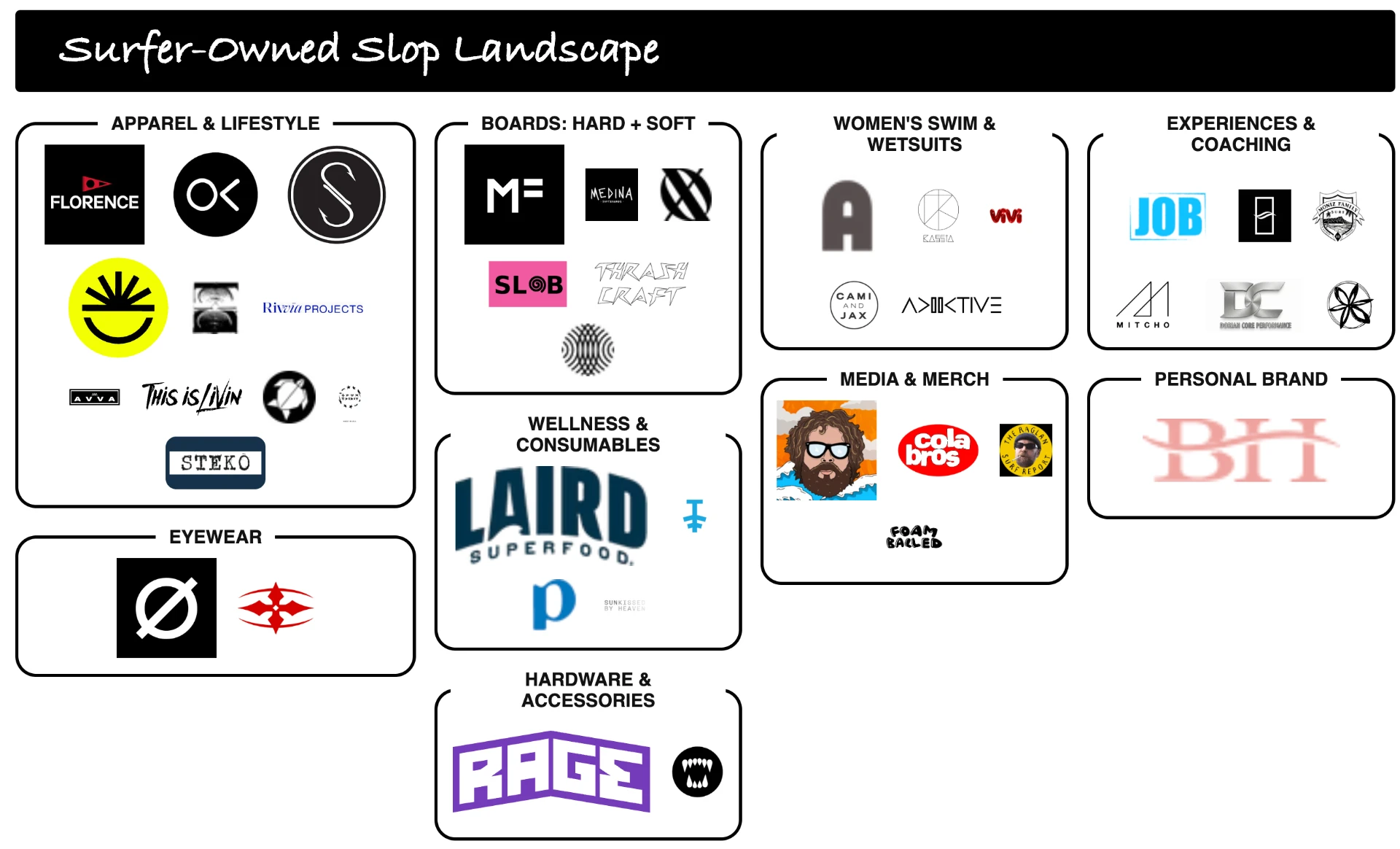
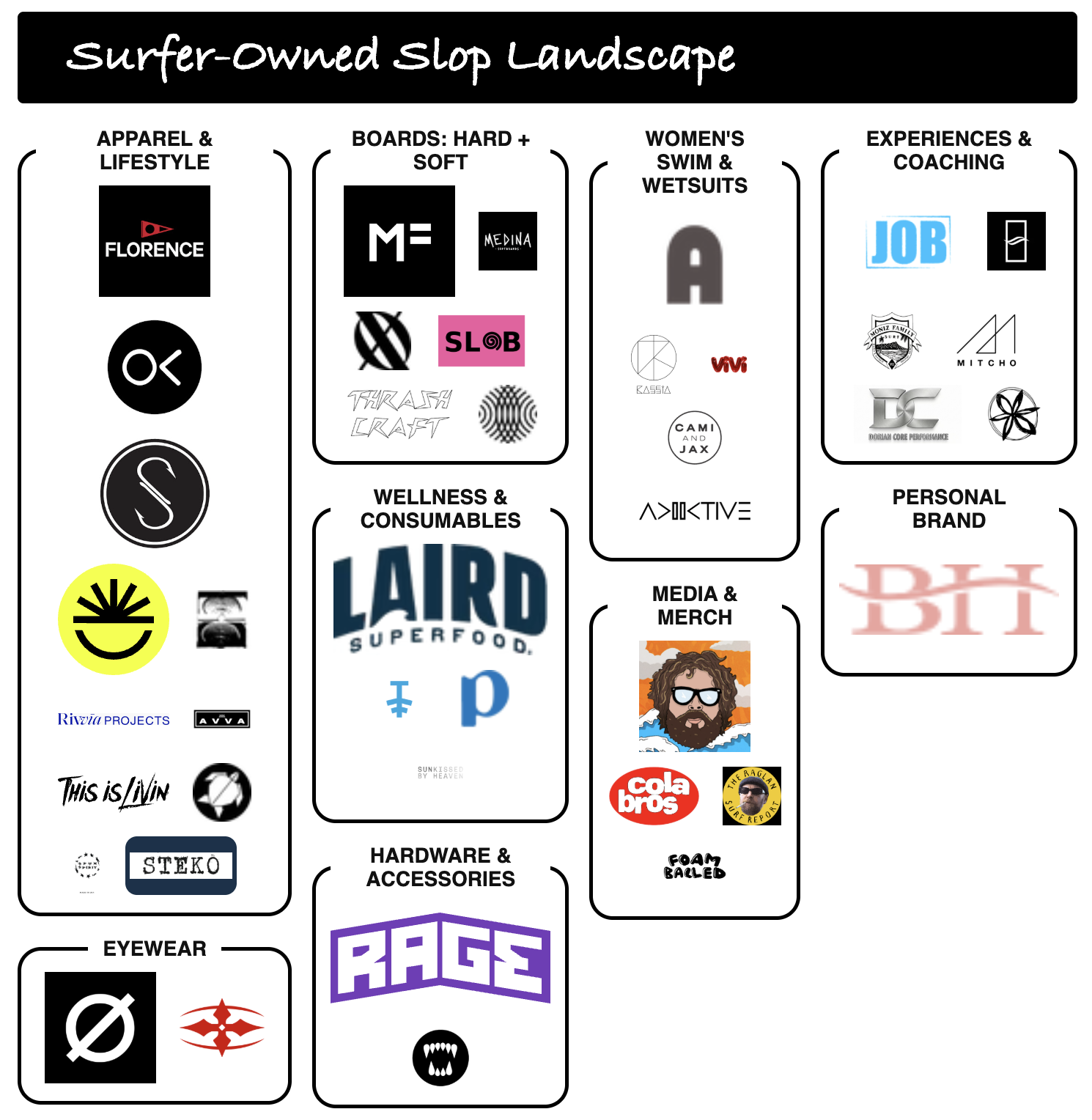
Provided is a snapshot into a reasonable sample size of the brand breakdown today -- don't sue me for missing a few.
A notable nuance here is that there are fundamentally two different business models here: the individual proprietor, and the operator-owned. For instance, Mick Fanning never operated anything himself; he rather put his name and capital into operator-run companies like Balter beer (~$100M exit) + his myriad of other ventures. The solo "individual" merch-store model, on the other hand, has a much greater risk of failure.
Let's break down the demographics a layer deeper:
Age: mean 38.7
- 3 founders under 30
- 13 aged 30–34 (notably large cluster)
- 10 aged 35–39
- 6 aged 40–44
- 6 aged 45–49
- 5 aged 50+
CT pedigree: 36%
- 13 former CT
- 3 current CT (alludes to the "brand-building is a post-tour move" concept being corroborated)
- 24 (55%) are free surfers/non-CT
- 4 miscellaneous
The story within the demographics is not in the age or experience of the surfers, nor the underlying need to annoyingly create a "simple" apparel business, an industry all of these surfers have been attuned to since age 12.
The real story lies within the power of themselves as surfers.
Most of the brand accounts have a shy following, compared to the founders' personal accounts. For instance:
- This is Livin' brand has 5.9k followers vs Koa Rothman's 435k, and growing.
- XO Coco brand has 27k followers vs Coco Ho's 643K.
- The JOB Surf Experience brand has 56K vs JOB's 1M+
Therein lies, brand equity living predominantly in the athlete, not the label. This in and of itself is not news, but this qualifies a very real founder-dependency risk for each of these businesses.
On the other side of the coin, the Largest brand-owned social media audiences are the operator-backed ones. Specifically, Laird Superfood (374k followers), Salty Crew (276k), Outerknown (286k), Sunkissed (218k). The smallest are the solo passion projects -- Akktive (1.1k), Resonance (4k), Pursuit (7k), Spun Spirit (6.9k).
So, Why Are Surfers Doing This Rather Than… Becoming A Real Estate Agent?
I won't speak on the latter meme, but it is fundamentally important to realize that the barriers to entry in apparel/ merch are almost zero, and surfers' one real asset - the audience of surfers who consume their surf content - maps perfectly onto it.
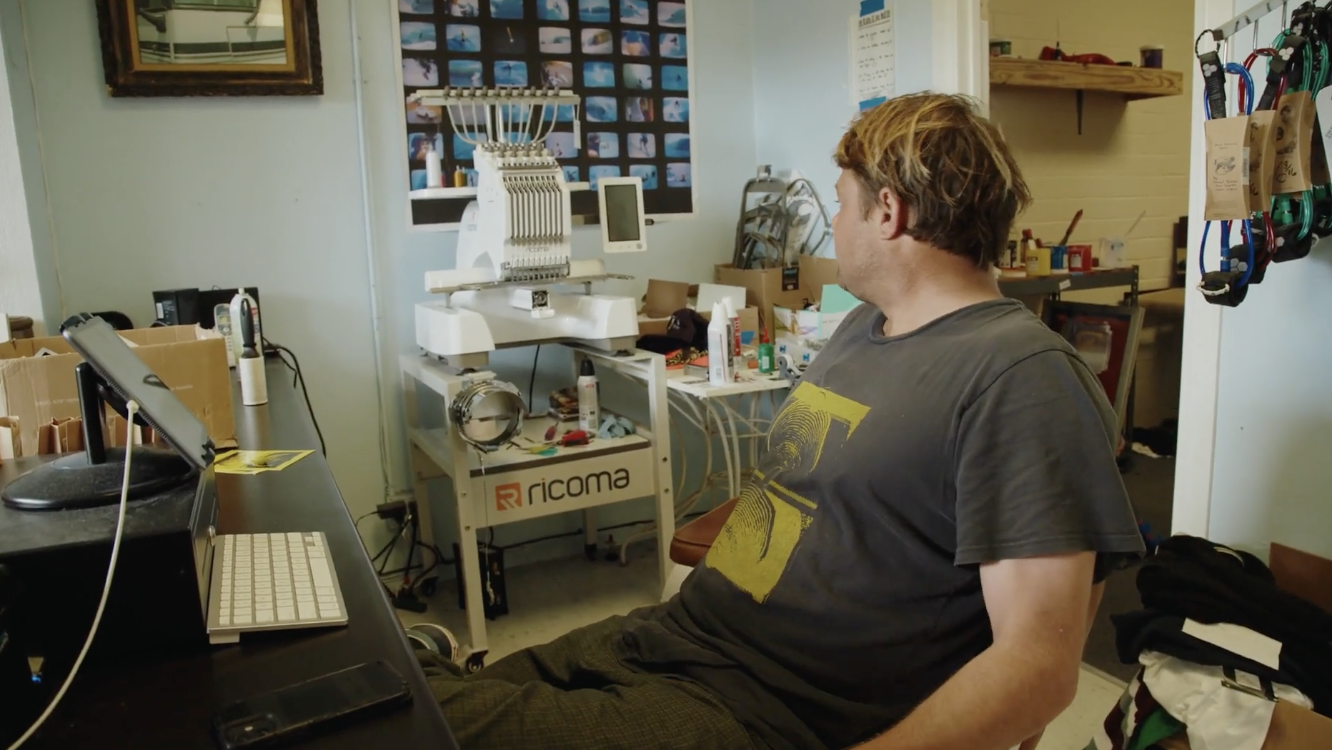
Give a Dane a Shopify account, access to a screen printer, hell -- some wholesale tee shirt hook-ups and an Anthropic account, and you're looking at launching a brand for $10,000 with no credentials, R&D, nor any inventory risk beyond some pallets sitting in a garage.
This truly validates that Surfers do not need to have valuable design skills (or even outsource them out in a costly fashion). Since they have an ethos and taste, they are able to use apparel to monetize themself.
Nobody is buying a Former tee for its sense of fashion (believe me), they are buying Dane Reynolds' taste.
The Barbershop Postulate
The Former example above identifies how lifestyle branding is marketable as hell, but particularly narrow. Even though the customer-acquisition cost is next to nothing, this entire model ceases to function the moment the audience stops growing.
This founder-dependency issue (we broached this earlier) can be further exemplified in:
The Barbershop Postulate -- continue selling "Dane" in order to monetize the merchandise.
A Barber like @javihaircuts isn't just selling scissors splicing hair; they are selling a lifestyle, along with the confidence to leave with a new individual sense of status and "man, I look GOOD" aura. Voilà, a routine chore, is now an emotional connection.
This is quite significant, due to the fact that the "Barbershop" itself is not something competitors to each of these brands can replicate -- each barber, eh-hem, surfer, has a unique audience relationship they are cultivating themselves.
The real risk here is that the only way to collect value from a surf audience is to sell the haircuts, not just sell the experience. This is the inverse of brands like Salty Crew and Laird Superfood, who are operator-owned; if the founder disappears, the product still flies off the shelves.
For this very reason, brands that fail to attract an audience to the athlete, like Steko22, have a real vanity risk. I started writing this in July, when Kolohe still had a virtually dormant instagram account. $50+ tee shirts with no personal online presence presents a huge scarcity issue that breaks the Barbershop model entirely. Kolohe is officially back online, and clearly scrambling -- gearing all of his personal content towards Steko promotions.
From our prior analysis, this is prone to fail, as Koloho is not operator-owned, and is not doing enough to nurture and refine an audience that wants to buy Kolohe.
Steko can't live on its own, it needs a hair guy.
The Winners
Winner 1: The Independent Brand With A Strong Barbershop Ratio
In context of the Liberated Brands collapse, there is a consistent pattern: as corporate surf (Quiksilver/Billabong/Volcom licensees) imploded, independent riders took the margin back. This completely disproved my initial gut feelings about seeing a "dumb little" logo on a "dumb new tee". There is a legitimate addressable market for genuine culture-builders - Former, Rage, Ritual Vision, Fun Day, Florence Marine X, Kassia, Moore Aloha, AVVA.
So long as they maintain a strong sense of self-credibility in their surfing image, vis-à-vis narrowing the gap between their personal brand popularity and their brand brand popularity, then they will likely see successful growth beyond 5-7 years.
Winner 2: The Operator-Owner Seeking Scale
These are the true "Industry-Expanders" -- Florence Marine X and Salty Crew are proven $20-100M operator-run bets, with athlete credibility. If JJF continues to capitalize this brand wisely, his persona grata amidst his spectacular Veia vids, will effectively grow his relationship with his audience, in addition to corresponding gear sales (double whammy!). That said, there are still risks of the "Operator-Owner" bracket; but it's more dog-eat-doggish. Assets can eat the operators, and operators can eat the assets.
Tread intelligently with investors; don't turn into a forced-hand-sellout-to-Private-Equity-story.
Winner 3: Consumables
Laird Superfood, Freaks of Nature.
Things I taste; things I apply.
This study shows us that consumables punch enormously above its weight, with Laird Superfood being the only company of legitimate scale (public, $40m+ annual revenue, sold in your local Target).
The kicker here is, Laird Superfood isn't framed as a surf brand at all -- it's cited as a grocer product. Their real target is the $11.9 trillion US grocery market (Grand View, 2021). Sure, we can narrow this down to the US coffee creamer market.. But this is still a $7.1 billion (6.8% CAGR) market, with powdered electrolytes being $2.7 billion alone.
Put next to a ruler for scale: Laird's creamer category alone is 1.5x bigger than all of surfing.
Consumables are objectively the winners here, as a logo-tee is bought once as a gift or impulse -- sunscreens, deodorants, supplements, and creamers are purchased monthly. Those repeat purchase are the difference between surviving past 7 years or not; to highlight this -- gross margins in supplements/skincare typically run 70–80% versus 50–60% for apparel and 30–40% for boards. Consumables compound the lifecycle of the customer.
According to Laird's recent 10-K earnings, the coffee, tea and hot chocolate market grew +37% to $15.3M, which is his fastest-growing line, driven by protein-filled coffee additions targeting younger-aged consumers. Creamers, his core franchise, grew +27% to $29.3M.
This is how Laird affords his Malibu compound, but there's a minor [massive] detail here: Laird and Gabby do not sell their personality like Dane Reynolds does -- they actually license it. There is a 30-day veto over new uses of the "Laird" brand, and it explicitly calls out Laird Apparel as being a conflict, competing for the founders' attention.
Translation? If Florence gets big enough, he may be contractually obligated to disclose to his shareholders if his name on any products poses a threat to any products other operators have ownership in.
Slater starting Freaks of Nature starting with a venture studio, outside ventures, and Amazon distribution is his attempt to not go through the same pains that Laird went though.
Still, this does not necessarily mean that anybody can just dive into consumables and scale like Laird has. Koa Smith's Foreign Waters is a textbook example of a surfer with surfer-likeness actively creating a subscription-first ($79/month, auto-refill) consumable product, with a Head of Science for formulation hired externally. The concept is actually quite inspiring if you know Koa's story; but this is extremely aggressive pricing that is not competitive enough. It took Laird 9 years and $147 million to turn Laird Superfoods into the revenue engine he has today -- Koa is going to need an enormous amount of capital to get out of "survival mode", but he is structurally on the right path.
Winner 4: Women
Here's where things get really interesting.
Women are far better at curating branded content to their [unisex] audiences. Barstool saw an immediate increase in female demographic involvement after hiring on Alex Cooper of the "Call Her Daddy" podcast, back in 2018 -- which ultimately became their most profitable podcast at the time.
The majority of the independent surf brands listed in this study are marketable to women, yet they are being completely ignored! Here's a breakdown:
| Brand | Where Women Can Be Inserted | Why it's the biggest miss |
|---|---|---|
| MF Softboards, Medina Softboards | Female team riders + women's dimensions in the range | Softboards are the beginner product, and beginners skew heavily female according to recent data. MF's own mission statement is about introducing "the next generation" — yet the entire brand face is male. Classic Fanno! |
| JOB Surf Experience, Weekend at Wilkos, Jamie Sterling | Female co-coach + a women's retreat product | Learn-to-surf and surf-travel are the most female-weighted segments in surf. Wilkos literally markets itself as ideal for a "Bucks weekend"; yet opts out of the fastest-growing travel category. Kassia already proved the retreat model works! |
| Protekt, Freaks of Nature, Foreign Waters, Sunkissed | Female co-founder/formulator with real authority, not an ambassador | Women dominate skincare and supplement purchasing. Four male-fronted consumables brands, and the only female-founded comp (Pursuit) is the one that attracted venture backing. This is lopsided, and ought to be adjusted. |
The irony here is, most of the women-founded brands in our study proved to be the most capital-efficient audience-builders on the list. Again, talk about linking a surf-ambassador to the brand [barber postulate] -- the females here, are experts at doing this affordably for the brand.
Furthermore -- this logic compounds with the consumables case above: skincare and beauty are categories where women dominate purchasing, and also drive the content that sells it. This is likely why our good friend Kelly Slater's Freaks of Nature (unisex) is competing in a market whose core is female.
What's driving me absolutely nuts, is that this can be an inexpensive win for these brands.
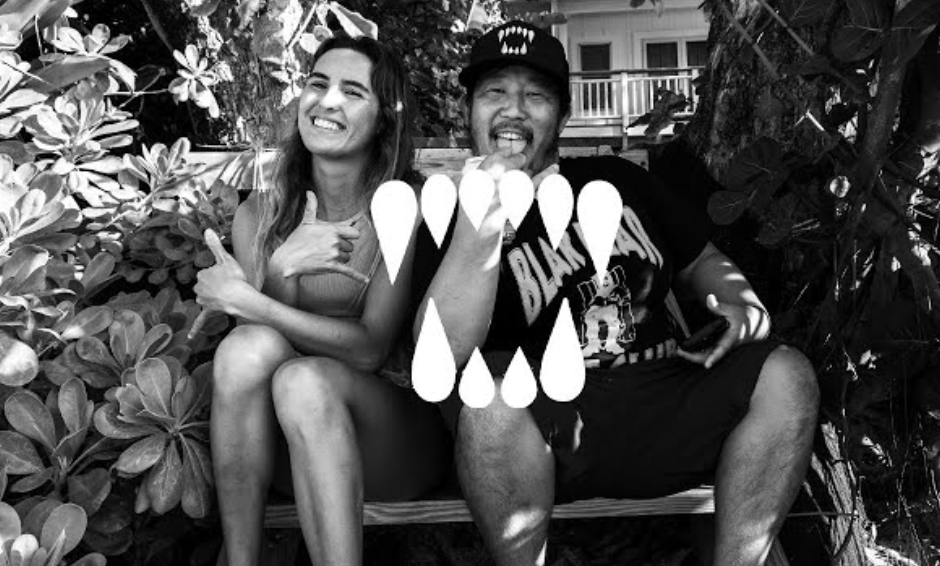
Blak Bear needs to be the poster child for this free-use template: Moana Jones-Wong's "The Wahine" signature pad uses their pre-existing manufacturing costs to simply… replicate a new pad for a net-new demographic.
Rage can replicate this tomorrow at no cost… yet they are not.
Final Winner: YOU, The Consumer
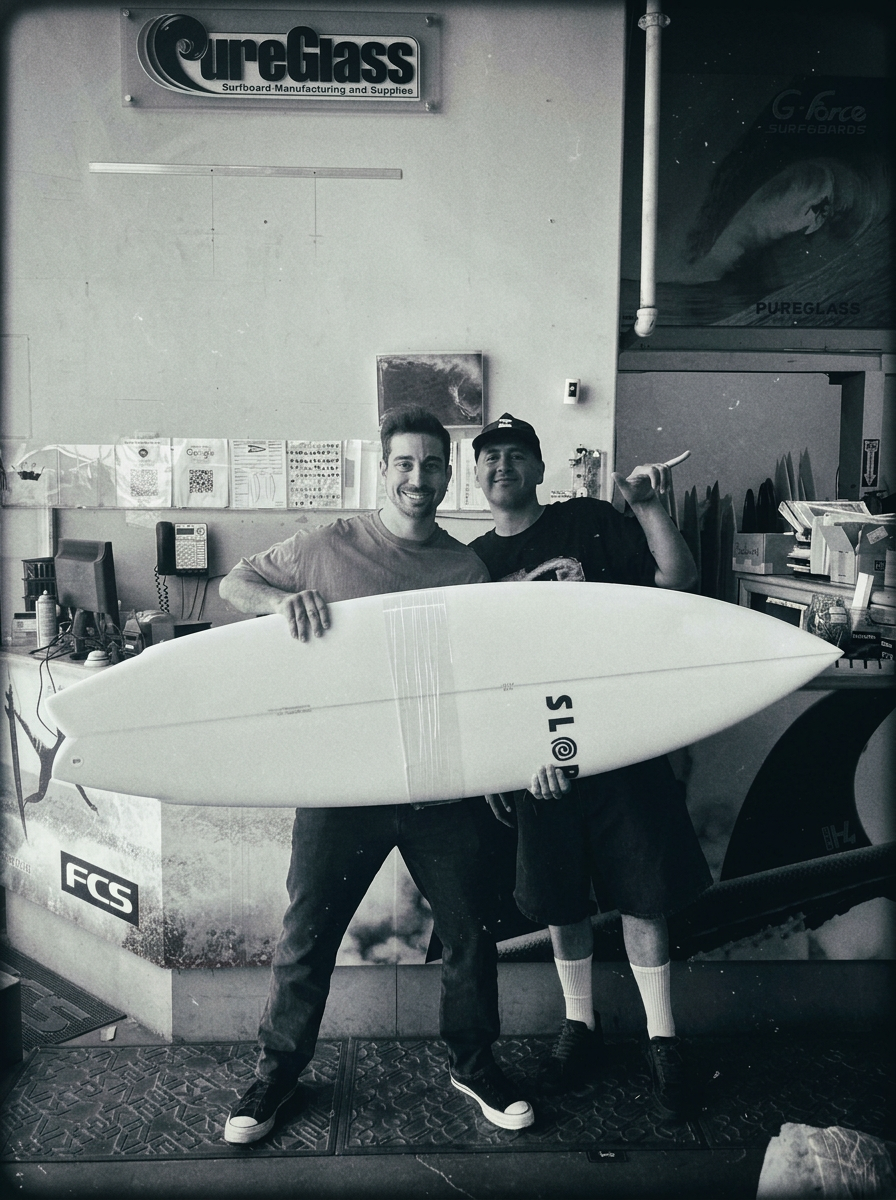
Journey Down to Costa Mesa: A month ago I DM'd Andrew DROID Doheny, after noticing he was shaping boards for the public. Asked him to shape me, we talked over the phone, over text, over instagram. I venmo'd his mom for the deposit on the board.
Finally met him in person, embarrassed myself talking his ear off about how we share the same birthday. We shared a great moment together -- we talked story, I opened up, he opened up. I left. We continued to DM about BS in the surf industry, memes, and obviously -- share vital feedback on the ripstick he shaped for me.
I've been watching DROID surf in Gromisodes, MetalNeck vids, and beyond, since I was pretty much a kid; and it was almost too surreal that I was now a part of his life, and he mine.
What other sports-driven industry fosters this experience?
Imagine buying a basketball from Kevon Looney himself. Too nuanced? Perhaps.
Irrespective, NOW -- This Week, Today, is the biggest opportunity in recent surf history for the typical civilian to make a personal connection with surfers they have always looked up to.
Shane Dorian will teach you how to do push-ups for a rather steep fee, Jamie Mitchell will teach you how to hold your breath for 17 minutes. Stroll into Chapter11.tv's flagship storefront in Ventura, and maybe Dane Reynolds himself, or one of the many freesurfing pros will hand you a bar of wax. Even Steko22. Kolohe is out there trying to spread brand awareness. Sarcasm and scrutiny aside, I'm confident he would go lengths to make a personal connection with people if it meant he could bring his vision to life.
This is unequivocally unbelievably exciting to the consumer.
Pour Conclure
The Surfer-Owned landscape is at a dramatic inflection point to both buyers and sellers… but the net-takeaway seems to actually be, both positive for the industry, and positive for the surfer. There are extensive narratives within this study, layers to peel away, dare I suggest we discuss the true "Core-ness" of all of these brands.
The fact of the matter is, big surf died, yet amidst the turmoil of being contractless, stickerless, and borderline broke… independent surfers picked up the pieces and created anew. This is gritty AF. Perhaps this is the college education they never had. Perhaps more.
So get out there folks, go buy that tee, that deodorant, that overpriced electrolyte packet.
Let's make this industry rebirth happen.
Comments
0 repliesSign in to join the thread.
Sign in / Sign up- No comments yet. Be the first.